nisab
How to Calculate Zakat: The 5th Condition, Nisab Thresholds, and the Simple 2.5% Formula
Quick Recap: The Five Boxes of Zakat
Zakat only becomes obligatory when all five conditions are met. Think of them as five checkboxes. Four out of five is not enough. Three out of five is not enough. All five must be checked.
| # | Condition | Quick Definition |
|---|---|---|
| 1 | Muslim | Any age, any mental capacity |
| 2 | Zakatable wealth | Specific types only (currency, merchandise, livestock, crops, minerals, buried treasures) |
| 3 | Full ownership | You can use, invest, and control it freely |
| 4 | Meets Nisab | Wealth reaches the minimum threshold |
| 5 | Full lunar year passed | A complete Islamic (Hijri) year passed on that wealth |
In Part 1, we covered conditions 1 through 4 in detail. This post focuses on Condition 5, the Nisab debate, how to calculate the amount you owe, and some of the most common real-life questions, including debt and fluctuating savings.
Condition 5: A Full Islamic Lunar Year Must Pass on Your Wealth
This is the condition that catches most people off guard, and the one that ties everything together.
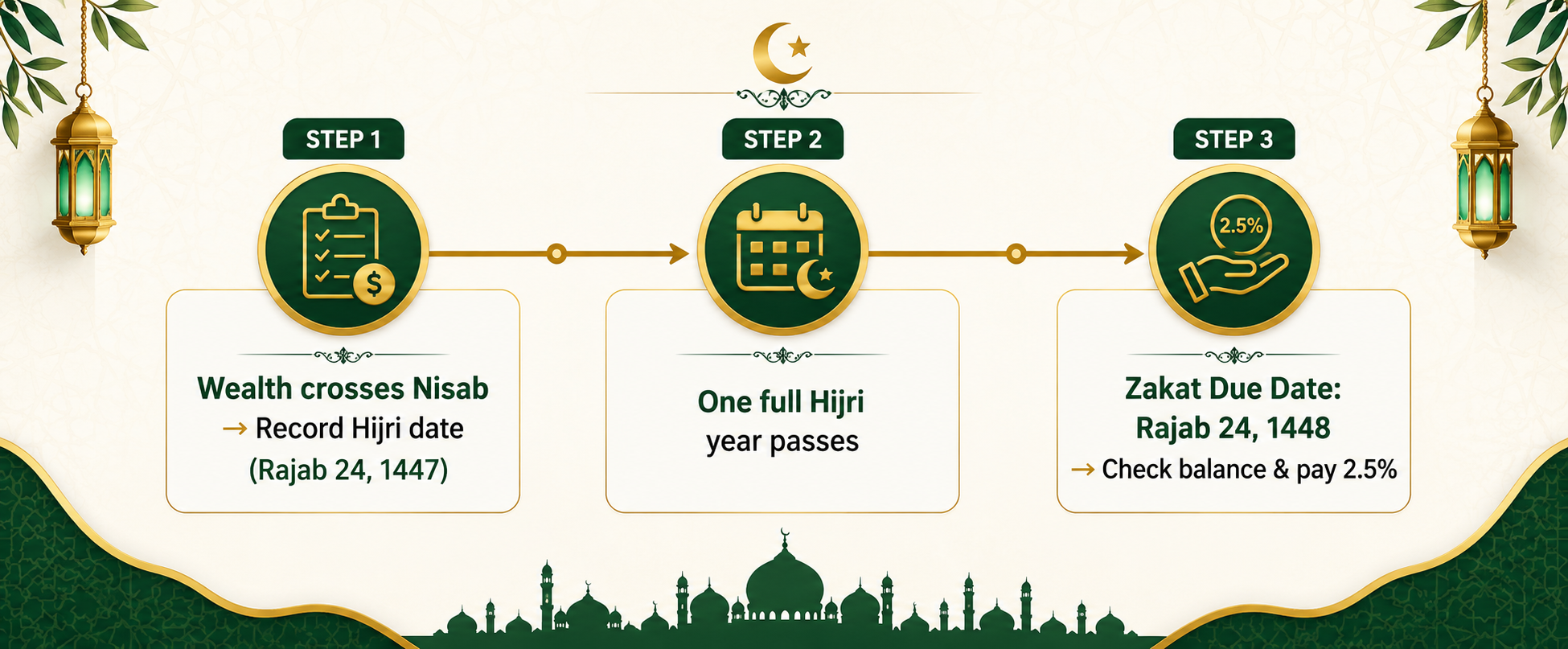
Once your zakatable wealth reaches the Nisab threshold, you start a clock, literally or figuratively. A complete Islamic lunar year, a Hijri year, must pass on that wealth before Zakat becomes due.
The Hijri Calendar, Not the Gregorian One
Allah says in the Quran that the calendar He recognizes consists of twelve months, and that is the Hijri calendar. Ramadan, Hajj, and Zakat are all tied to it.
"The number of months with Allah is twelve lunar months" - Surah At-Tawbah, 9:36
The Hijri year is approximately 11 days shorter than the Gregorian year. So your Zakat Due Date (ZDD) shifts slightly every year on the standard calendar.
What you need to do: The day your wealth first crosses the Nisab, record that date in the Hijri calendar, not the Gregorian one. Any free Hijri converter online will do it in seconds.
Example: If your savings crossed the Nisab on January 13th, 2026, that converts to Rajab 24, 1447 AH. Your Zakat Due Date is then Rajab 24, 1448 AH, one full Islamic year later.
What Happens If Your Wealth Goes Up and Down During the Year?
You probably know this, but money is never static. Your savings go up when you get paid and down when you pay bills. So what number do you actually pay Zakat on?
The most widely followed method in North America is the Zakat Due Date method (at least that is what Majed Mahmoud has coined it as). This is the Hanafi ruling:
- Look at how much zakatable wealth you have on your Zakat Due Date
- That is the number you pay 2.5% on
- What happened in between does not matter
Whether your balance doubled during the year, dropped to zero in the middle, or went through ten different fluctuations, what counts is the snapshot on your ZDD. It is simple and it is not complicated.
Example: You started the year with $2,000. At some point it grew to $10,000. On your Zakat Due Date, you have $4,500. You pay 2.5% of $4,500 = $112.50.
⚠️ NOTE: The remaining three of the four major madhabs (Maliki, Shafi'i, and Hanbali) are stricter in this regard and require the Nisab to be maintained throughout the year, meaning a drop below the Nisab at any point within the year resets the clock.
Do You Pay Zakat on Just the Profit or the Full Amount?
Some people assume Zakat is only owed on the gain, the increase in wealth over the year. That is not correct.
Zakat is paid on the total amount of zakatable wealth on your ZDD, not just the difference.
This comes from the original formula: for every 40 dinars, you pay 1 dinar. 1 ÷ 40 = 2.5%. It applies to the whole zakatable balance, not the increment.
Ibn 'Umar and 'Aishah narrated that: From every twenty Dinar or more. The Prophet used to take half a Dinar and from forty Dinar, one Dinar. (Sunan Ibn Majah)
Example: You had $10,000 at the start of the year. On your ZDD, you have $15,000. You pay 2.5% of $15,000 = $375, not just 2.5% of the $5,000 increase.
The Nisab Debate: Gold Standard vs. Silver Standard
Scholars have two main positions on which Nisab threshold to use for cash and currency.
Use the Gold Nisab (~$12,000+ at the time of writing)
The threshold is 85 grams of gold (87.48g in another opinion).
Arguments for:
- Gold has historically been the primary monetary standard; many currencies were once pegged to it
- Gold's value aligns more consistently with other categories of zakatable wealth (like livestock thresholds)
- Silver fluctuates extremely and its relative value has dropped significantly in modern times. 595 grams of silver no longer represents meaningful wealth
Who holds this view: Several prominent North American scholars advocate for the gold standard.
Use the Lower of the Two (Usually Silver, which is at ~$1,600+ at the time of writing)
The threshold is 595 grams of silver (612.36g in another opinion), or whichever of gold or silver is lower at the time.
Arguments for:
- Using the lower threshold means more Muslims are obligated to pay, which means more wealth reaches the poor and needy
- It is adopted by major international bodies including the Islamic Council of the Muslim World League
- It errs on the side of fulfilling the right of the poor
Who holds this view: The Muslim World League and many contemporary scholars who prioritize maximizing benefit to the needy.
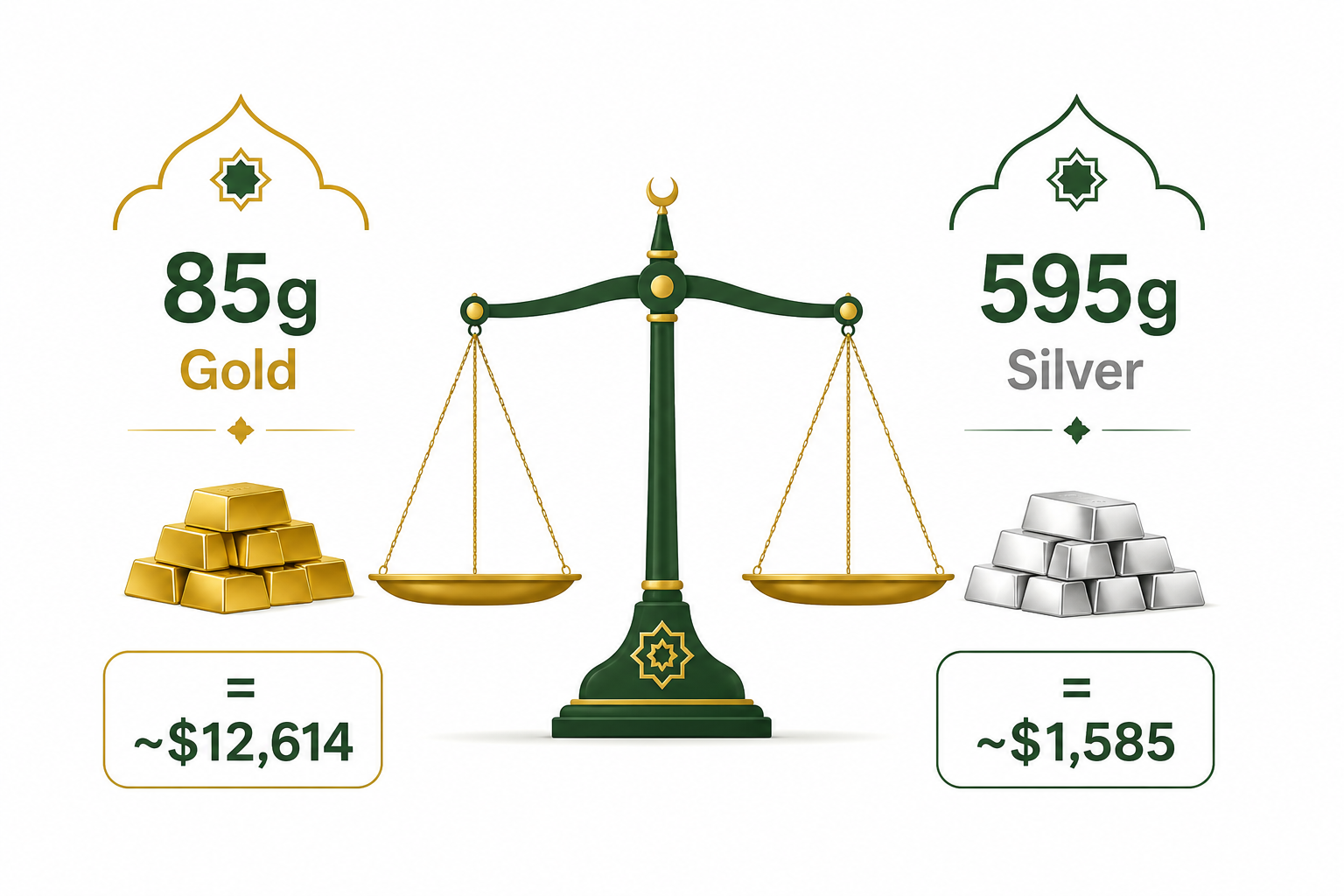
For this guide, we follow the position of using the lower of the two thresholds, which today is the silver Nisab.
Nisab values change constantly with precious metal prices. Before paying your Zakat, always verify the current silver and gold gram prices and recalculate. Many Islamic organizations publish updated Nisab values monthly.
⚠️ NOTE: Many use the Nisab threshold of 87.48g for gold and 612.36g for silver. This opinion is also held by many major organizations, including Islamic Relief and Muslim Aid.
Nisab Thresholds by Wealth Type
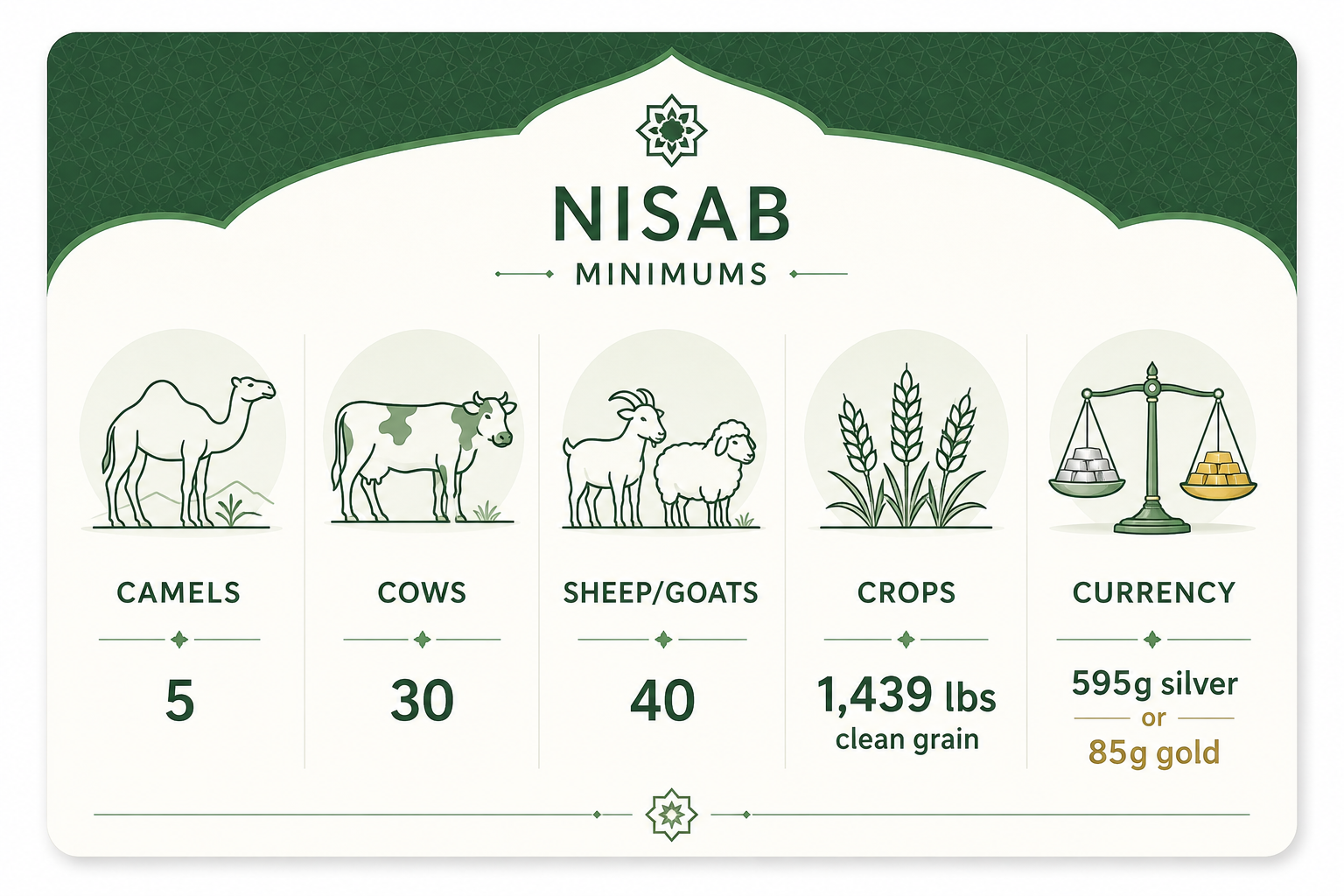
Nisab is not one-size-fits-all. Each category of zakatable wealth has its own minimum threshold.
Currency & Cash
| Standard | Grams | Approx. Value (at time of writing) |
|---|---|---|
| Gold | 85g | $12,000+ |
| Silver | 595g | $1,600+ |
Add up all your cash, including bank accounts, savings accounts, cash at home, and crypto holdings, across all countries and currencies. If the combined total meets the threshold, you've checked Box 4.
Livestock
| Animal | Minimum to owe Zakat |
|---|---|
| Camels | 5 |
| Cows / Buffalo | 30 |
| Sheep / Goats | 40 |
If you have 4 camels, 25 cows, or 35 goats, you're under the threshold. No Zakat on livestock.
Crops & Agricultural Produce
The Nisab for crops is approximately 1,439 lbs (653 kg) of clean, usable grain per harvest, after removing husks, stalks, and shells. Your backyard garden almost certainly does not come close.
IMPORTANT: One important distinction: Crops do not require the one-year condition. Zakat on crops is due at the time of harvest, not after a full lunar year.
Do I Add Up All My Money From Different Accounts?
Yes. If it is the same type of zakatable asset, you combine it all.
Cash is cash, regardless of which bank it sits in, which country, or what currency it's denominated in. On your Zakat Due Date, add up:
- Checking accounts
- Savings accounts
- Cash at home
- Cash held abroad (in Yemen, Palestine, Canada, wherever)
- Cryptocurrency (converted to dollar value)
Add them all together, then check whether the combined total meets the Nisab. If yes, you owe Zakat on the total.
How to Calculate Your Zakat: Step by Step
-
Step 1 — Identify your Zakat Due Date (ZDD)
The day your wealth first crossed the Nisab. Convert it to the Hijri date and add one full year. -
Step 2 — On your ZDD, check your balance
Add up all zakatable currency: cash, bank accounts, crypto, gold and silver held for savings. -
Step 3 — Check the current Nisab
Verify the current silver Nisab (or gold, based on your preferred opinion). -
Step 4 — Confirm your balance exceeds the Nisab
If it does, proceed. If not, no Zakat is due this year. Reset your clock for when it does. -
Step 5 — Multiply your total by 2.5%
Zakat = Total Zakatable Wealth × 2.5%
Tabulated Example:
| Your Zakatable Wealth | Zakat Owed (2.5%) |
|---|---|
| $1,683 (Nisab) | $42.08 |
| $2,000 | $50.00 |
| $5,000 | $125.00 |
| $10,000 | $250.00 |
| $25,000 | $625.00 |
| $50,000 | $1,250.00 |
What About Debt? Does It Reduce My Zakat?
This is one of the most debated questions in Zakat, and scholars have genuinely different views.
Debt doesn't reduce Zakat
Whatever cash you have on your ZDD, pay 2.5% on it. Your debts are a separate matter between you and whoever you owe.
Deduct short-term debts
If you have an immediate, pressing debt, like money you owe right now that you must pay, some scholars allow you to deduct it from your zakatable total before calculating.
The modern nuance
The classical ruling on deducting debt was designed for a time when loans were short-term and personal. Today, debt looks very different:
- A 30-year mortgage on a rental property you profit from
- A student loan you're slowly paying off while building wealth
- A car loan on a vehicle you own and use
Contemporary scholars caution against using long-term investment loans to avoid Zakat. If you borrowed money to grow wealth, that debt does not necessarily exempt you from Zakat on the wealth you currently hold.
If you have a mortgage on your home, credit card debt, or student loans, most scholars would still advise paying Zakat on your liquid cash and savings. Consult a knowledgeable scholar if your debt situation is complex.
What About 401k, IRA, and Retirement Accounts?
Retirement accounts involve incomplete ownership, which affects Condition 3 (full ownership). The ruling varies based on the type of account and your ability to access the funds. This topic will be covered in another blog.
Frequently Asked Questions
Q: What if I never recorded the date my wealth first crossed Nisab?
If you've had savings above the Nisab for a while but never tracked it, scholars advise making your best estimate, repenting for what may have been missed, and starting fresh with a recorded date going forward.
Q: Is there Zakat on cryptocurrency?
Yes, most contemporary scholars treat cryptocurrency as a form of currency. Convert your holdings to dollar value on your ZDD and include it in your total.
Q: Do I combine gold jewelry and cash when calculating Nisab?
If you're following the majority opinion (no Zakat on personal-use jewelry), do not include it. If you follow the Hanafi opinion that jewelry is zakatable, include it. Be consistent with whichever position you follow.
Q: If my savings are exactly at the Nisab, do I owe Zakat?
Yes. Once you meet or exceed the Nisab, the threshold is crossed. Zakat is due after the full year passes, assuming your balance is still at or above Nisab on your ZDD.
Your Annual Zakat Checklist
Keep this for next year. On your Zakat Due Date, run through it:
- Am I Muslim?
- Is my wealth zakatable?
- Do I have full ownership and control?
- Does my total meet the Nisab?
- Has a full Hijri year passed since I first met Nisab?
If all of the above are checked, then:
- Choose eligible recipients — one of the 8 Quranic categories (covered in Part 4)
Calculate: Total zakatable wealth × 2.5% = Zakat owed
Closing Thought
$50 on $2,000. $250 on $10,000. The math takes thirty seconds. Knowing the rules well enough to apply them correctly — that's the actual work, and it's what most people skip. Zakat that's calculated right reaches the people it was meant for. May Allah accept yours, bless your wealth, and make your giving easy. Ameen.
This is Part 2. Part 1 covers the meaning of Zakat, conditions 1–4, and the Zakat vs. Sadaqah distinction. Part 3 covers Zakat on retirement accounts (401k, IRA, HSA) and trade merchandise. Part 4 covers the 8 eligible recipients of Zakat.
Related articles

Qurbani (Udhiyah): The Animal, the Timing, the Slaughter, and the Distribution — A Complete Practical Guide
Which animals are valid for Qurbani? What defects invalidate the sacrifice? When must it be slaughtered? How is the meat distributed? Every practical question answered with scholarly sources.

Qurbani (Udhiyah): The Sacrifice of Eid al-Adha — What It Is, Who Owes It, and What Happens If You Miss It
What is Qurbani and who is required to give it? Learn the basis, the ruling across the madhabs, who qualifies, if one sacrifice covers a whole household, and what to do if you've missed in past years.
Zakat Explained: What It Is, Why It Matters, and How to Know If You Owe It
Learn everything you need to know about Zakat — its meaning, the 4 key conditions that make it obligatory, nisab thresholds for 2026, and the most common mistakes Muslims make when paying it.