nisab
Zakat Explained: What It Is, Why It Matters, and How to Know If You Owe It

"I Give More in Charity Than I Owe in Zakat" - Is That Enough?
Have you ever said something like this or heard someone say it?
"I don't know exactly how to calculate my Zakat, but trust me bro, I give way more in charity than I'm supposed to."
It sounds generous. It feels like enough. And the intention behind it is genuinely good. But here's the problem: Good intentions don't automatically fulfil a pillar of Islam.
Zakat isn't just a donation. It's an act of worship with specific rules around intention, timing, and who actually receives it. General charity, no matter how much of it you give, does not count as Zakat unless those conditions are met. That's not a technicality. That's the deen.
Here's the easiest way to understand it: If you prayed 100 Sunnah rak'ahs, would that replace your two obligatory Fajr rak'ahs? Of course not. The same principle applies to Zakat.
This guide breaks down exactly what Zakat is, why it carries such weight in Islam, and four conditions out of five that determine whether it's obligatory on you (the fifth is explained separately). All in plain language, so no fiqh degree required.
Note: The information has been taken from Majed Mahmoud’s video series on Zakat. The link to his YouTube video playlist has been provided below.
So What Actually Is Zakat?
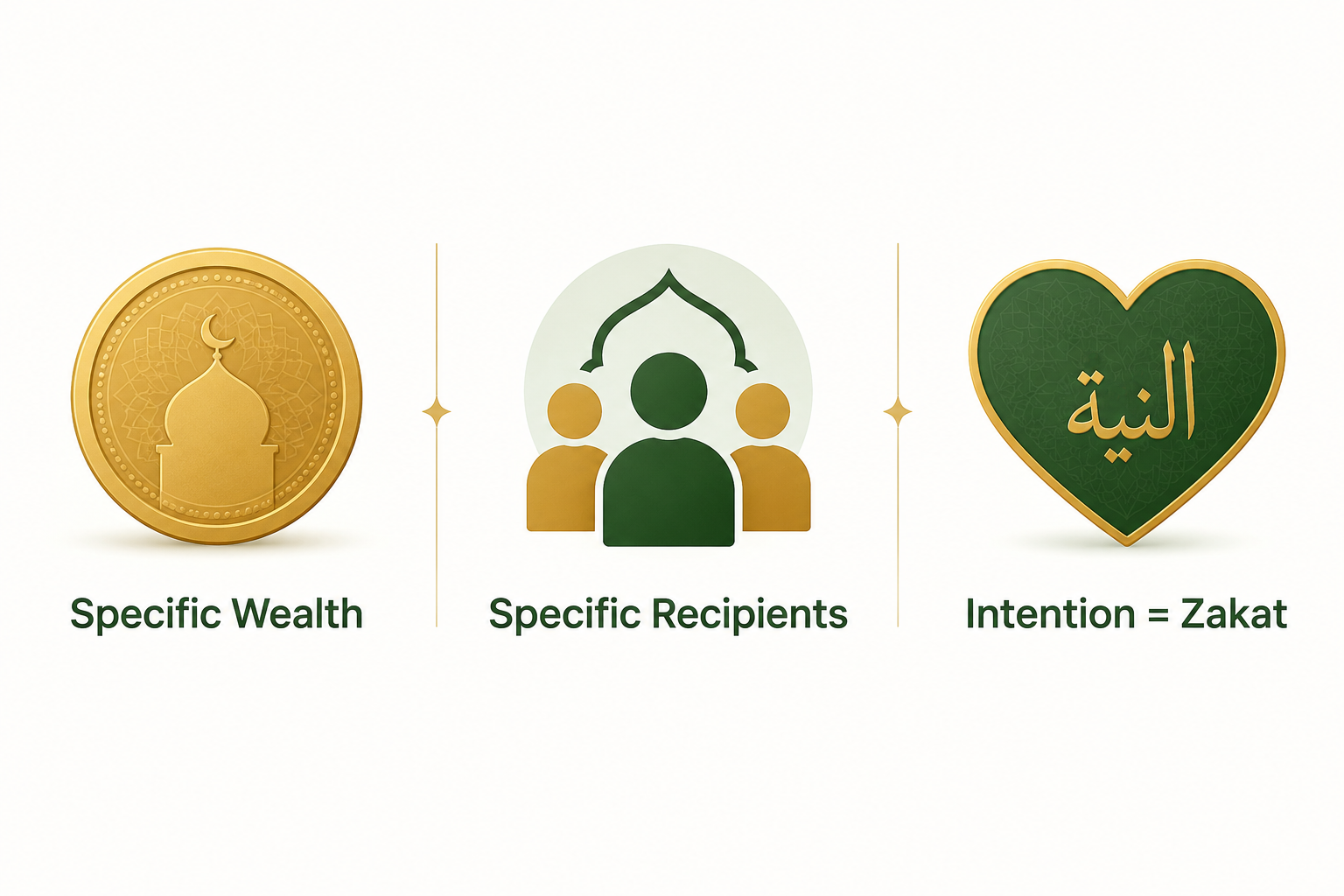
Zakat is an act of worship in which a Muslim gives a specific, obligatory share of their qualifying wealth to specific categories of recipients, as defined by the Quran and Sunnah.
Every word in that sentence matters:
- It comes from specific types of wealth — not everything you own qualifies
- It goes to specific categories of people — not just any cause or charity
- It requires a clear intention that what you're giving is Zakat — not sadaqah, not a donation, but Zakat
Miss any one of those, and what you gave may be a beautiful act of charity. But it doesn't fulfill your Zakat.
What Does "Zakat" Actually Mean?
The word Zakat in Arabic carries two meanings, and both are worth sitting with.
1. Purification
When you pay Zakat, something gets cleansed, and it's not just your bank account. The Prophet ﷺ taught that charity extinguishes sins the way water puts out fire. But the purification goes deeper than your own book of deeds.
It purifies your wealth too. Think about it: How many of us can say our income is 100% beyond question? I cannot. And in business especially, things slip. Words get exaggerated, deals feel off, the line between halal and doubtful gets blurry. Some part of the income feels "Mushbooh" ('doubtful' or 'suspect', used for food but isn't what we earn used to buy us food?) Zakat is one of the ways Allah gave us to clean that up.
It purifies your heart from stinginess. Giving isn't just a financial transaction. It trains the soul. Every time you give, you loosen the grip money has on you, a little more each time.
And something that people don't talk about enough: It purifies the receiver's heart too. When someone sees you thriving and struggling themselves, envy and resentment can creep in. When they receive their rightful share of your Zakat, that bitterness softens. The system is designed to heal both sides of the transaction.
2. Growth
Yes, Zakat literally means growth. And the Prophet ﷺ was clear: No one has ever lost wealth by giving in charity. But growth doesn't always look like a direct return in your bank account.
Sometimes it's a bill that comes in lower than expected. A repair that should've cost $1,000 that costs $500. A driveway that holds up for 10 years when it should've needed replacing in five. Allah chooses how to return what you gave, and He's a far better investor than any fund manager. Your job is to give it and trust the One you're giving it to.
Why Does Zakat Carry Such Weight?
Because it's a pillar. One of five. And you already know what happens to a structure when you remove one of its pillars.
When Abu Bakr As-Siddiq (RA) became Caliph, some tribes stopped paying Zakat after the Prophet's ﷺ death. Abu Bakr's response shook even the Sahabah: He declared war on them. His companions pushed back. They said that those people still prayed, so how can he fight them? His answer was firm: That he would fight anyone who separates Salah from Zakat.
That's how the first generation of Muslims treated it.
What makes Zakat uniquely heavy among the pillars is this: It's not just between you and Allah. There are actual people on the other end — the poor, the struggling, the indebted — who have a *right* over your wealth. It's not charity you're ch
oosing to extend. It's something that already belongs to them, sitting in your account.
And if you still need weight added to that, there's an authentic hadith describing what happens on the Day of Judgment to those who withheld Zakat on gold and silver:
Allah's Messenger (ﷺ) said, "Whoever is made wealthy by Allah and does not pay the Zakat of his wealth, then on the Day of Resurrection his wealth will be made like a baldheaded poisonous male snake with two black spots over the eyes. The snake will encircle his neck and bite his cheeks and say, 'I am your wealth, I am your treasure.' " Then the Prophet (ﷺ) recited the holy verses: 'Let not those who withhold . . .' (to the end of the verse). (sunnah.com)
May Allah protect us.
Zakat vs. Sadaqah — They're Not the Same Thing
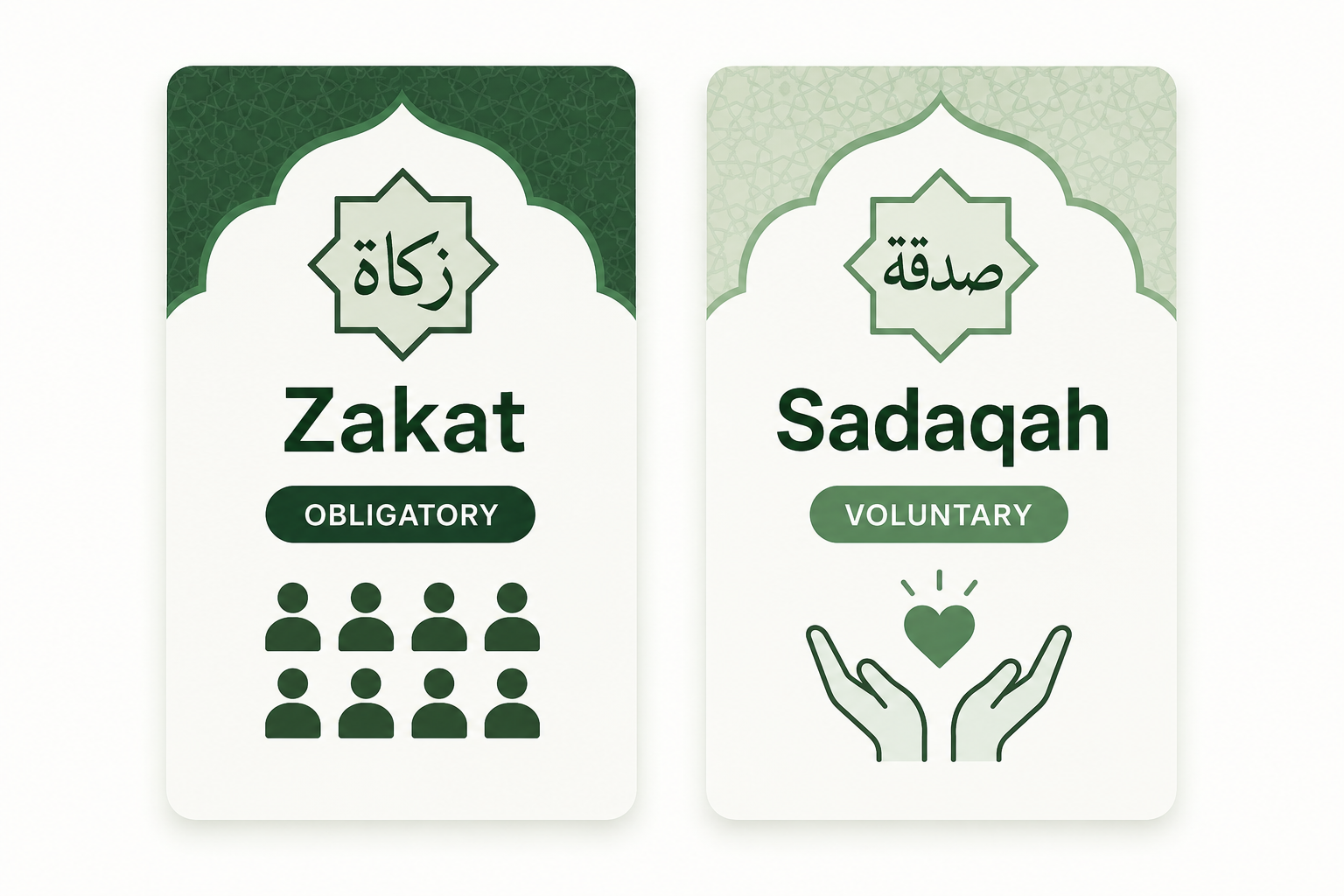
In the Quran, both words sometimes appear interchangeably. But in everyday usage today, they refer to two very different things and mixing them up is one of the most common Zakat mistakes people make.
| Zakat | Sadaqah | |
|---|---|---|
| Obligation | Obligatory (Fard) | Voluntary |
| Intention Required | Yes — must intend it as Zakat | No specific intention needed |
| Recipients | One of 8 specific Quranic categories | Anyone in need |
| Timing | Islamic Lunar (Hijri) Calendar | Anytime |
| Minimum Amount | Must meet Nisab threshold | No minimum |
Next time you donate online, look closely at the options. Many reputable relief organizations give you a dropdown: *General Donation* or *Zakat*. That choice matters more than most people realize. When you designate it as Zakat, the organization is held to a stricter standard — the funds must reach eligible recipients, and operational expenses are limited. Zakat money is handled differently because it is different.
The 4 Conditions That Make Zakat Obligatory on You
Zakat doesn't apply to everyone automatically. There are five conditions that all have to be met. Like five checkboxes. Miss one, and Zakat isn't yet due on that wealth. We'll cover four of them here; the fifth (a full lunar year passing) gets its own dedicated post.
Condition 1: You Must Be Muslim
This is straightforward enough. Zakat is an act of Islamic worship, so it applies to Muslims.
What surprises many people is what *doesn't* restrict it: Age and mental capacity. Unlike Salah, which is only obligatory on adults who are of sound mind, the majority of scholars hold that Zakat applies to the wealth of children and those who are mentally incapacitated as well.
The reasoning comes from Surah At-Tawbah (9:103):
"Take from their wealth charity to purify and bless them."
Allah didn't say "take from the wealth of adult, sane Muslims." The command is general.
In practice, it's the guardian (a parent, trustee, or appointed caretaker) who is responsible for calculating and paying Zakat on that person's behalf.
Worth noting: Imam Abu Hanifah holds a different opinion. He argues that since children and those who lack mental capacity aren't legally addressed by Islamic obligations (no haram, no wajib applies to them), Zakat shouldn't be binding on their wealth either. This is a respected scholarly position. If you or your family follows the Hanafi madhab on this specific issue, that's valid. Don't let anyone make you feel otherwise.
Condition 2: The Wealth Must Be a Zakatable Type
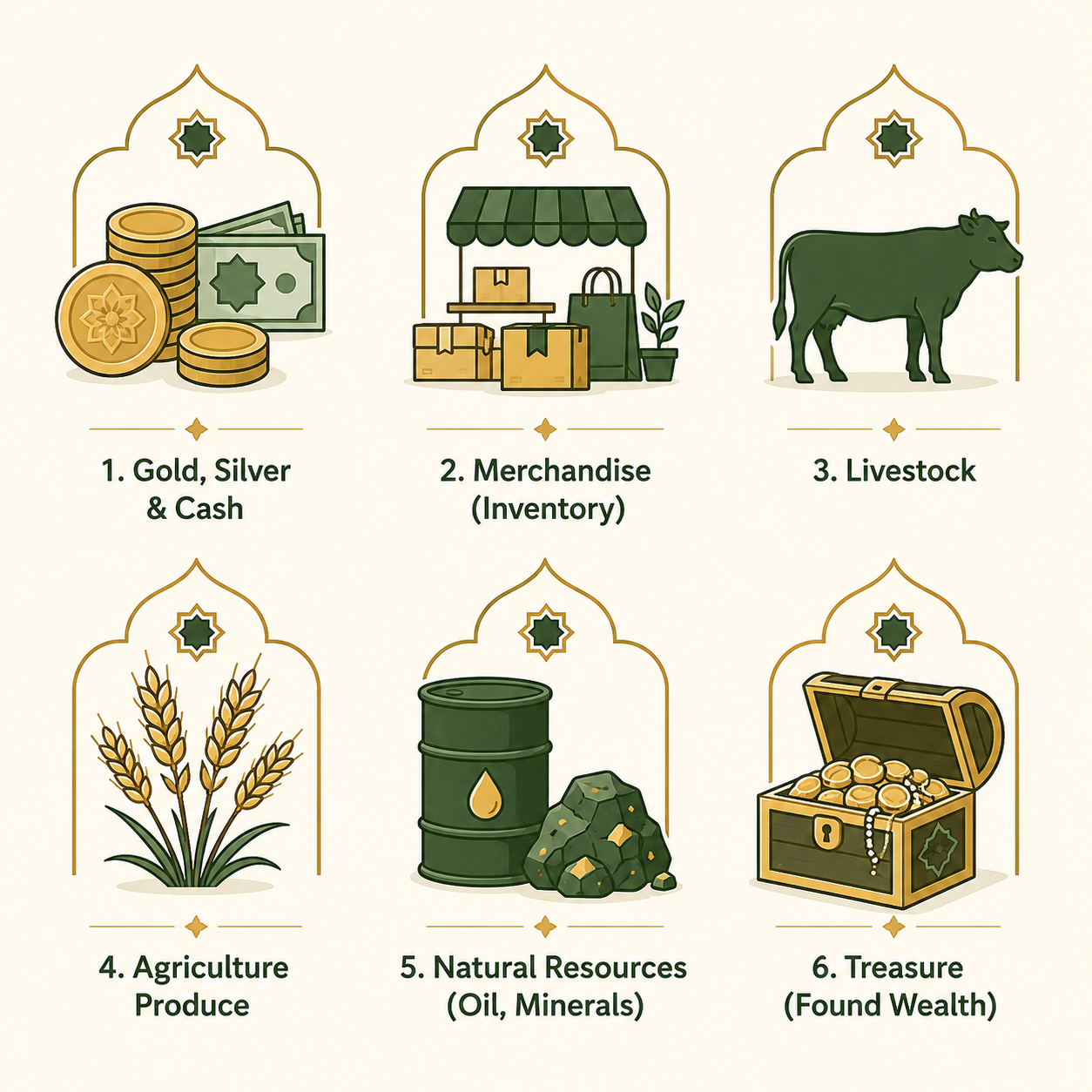
Your laptop isn't zakatable. Neither is your car, the house you live in, your furniture, or your personal belongings. Zakat only applies to specific categories of wealth:
1. Currency — Cash on hand, money in bank accounts, gold, silver, and (in most contemporary scholarly opinion) cryptocurrency
2. Merchandise and trade goods — Inventory you intend to sell: Products, stock, even a car dealership's vehicles
3. Livestock — Camels, cows, buffalos, goats, sheep — under specific conditions
4. Agricultural produce — Wheat, barley, corn, dates, raisins — above a minimum harvest threshold
5. Minerals and natural resources — Precious metals, oil, copper, iron — things extracted from the earth
6. Buried treasure (Rikaz) — Yes, this is a real category with its own ruling
Realistically, for most Muslims living in the West, only Category 1 — currency — is relevant. Everything else is worth knowing, but cash, savings, gold, and silver is where most people's Zakat calculation begins and ends.
Condition 3: You Must Have Full Ownership
This one catches people off guard. You don't pay Zakat on money you can't actually access or control.
Full ownership means the wealth is yours to use, invest, or spend — right now, without anyone's permission. If that's not the case, the Zakat clock doesn't start.
A few real-world examples of where this gets complicated:
- A promised gift — Your parents tell you in March they're sending you $500 for Eid. Your Zakat due date is tomorrow. That $500 doesn't count because you don't have it yet.
- A loan you gave someone — The money is technically yours, but you can't use it or control it. Most scholars say this is debatable depending on the borrower's situation.
- Retirement accounts (401k, IRA, HSA) — These are nuanced because your level of access varies. It will be covered in detail in a later post.
The principle is simple even when the cases get complicated: If you can't use it, invest it, or access it freely, it's probably not fully yours for Zakat purposes yet.
Condition 4: Your Wealth Must Reach the Nisab
Nisab is the minimum threshold your zakatable wealth has to reach before Zakat kicks in. Think of it like the customs limit when you return to the US from abroad. If it is under the threshold, then there's no duty. Over it, and you're required to report. Same idea here.
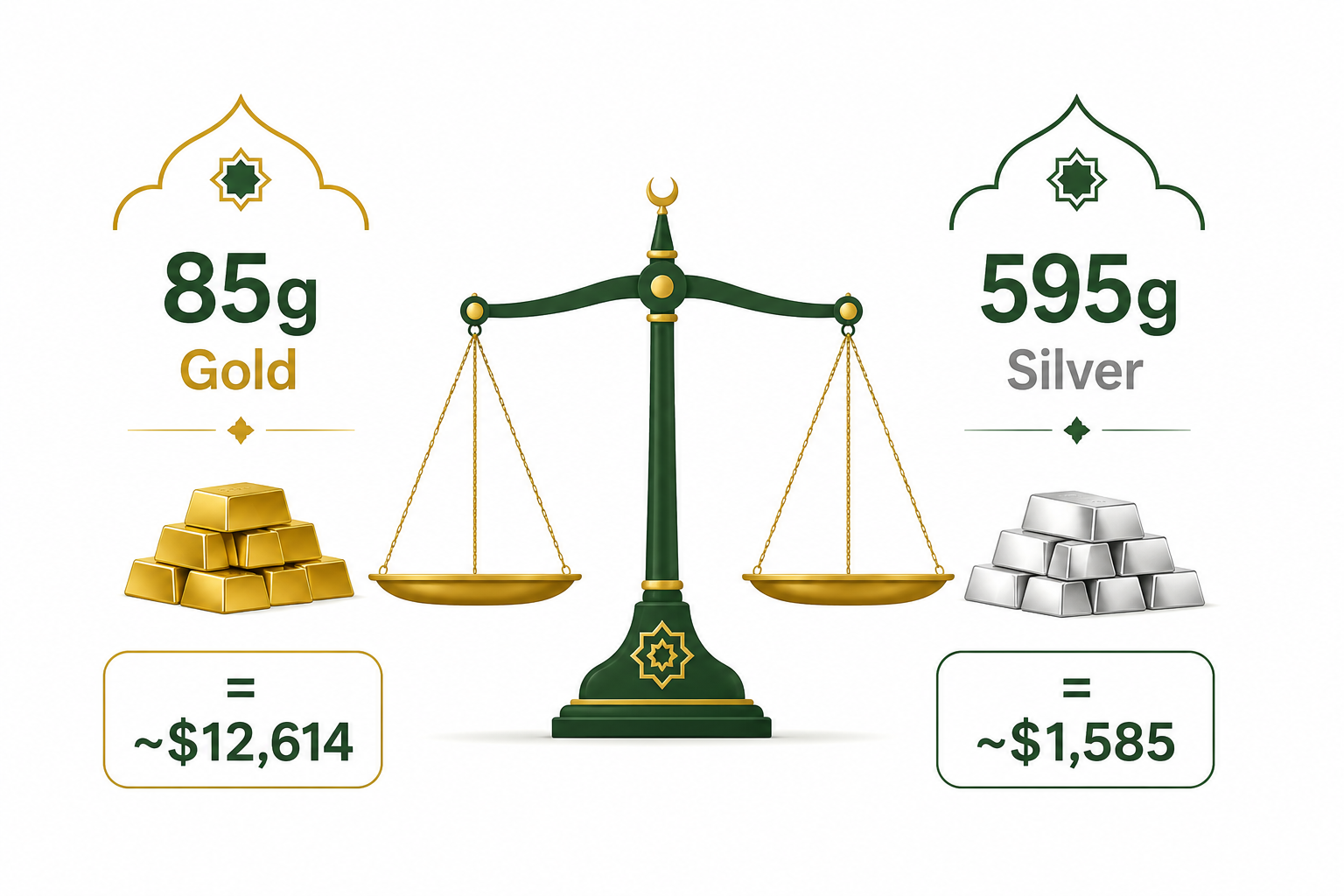
The Nisab is measured in gold or silver:
- Gold Nisab: 85 grams
- Silver Nisab: 595 grams
As of writing this post:
- Silver Nisab ≈ $1,500+
- Gold Nisab ≈ $12,000+
Scholars have an ongoing discussion about which standard to apply to cash. Many contemporary scholars recommend using the silver Nisab (~$1,500+) because it's more inclusive, meaning more people's wealth gets accounted for and more Zakat reaches those who need it.
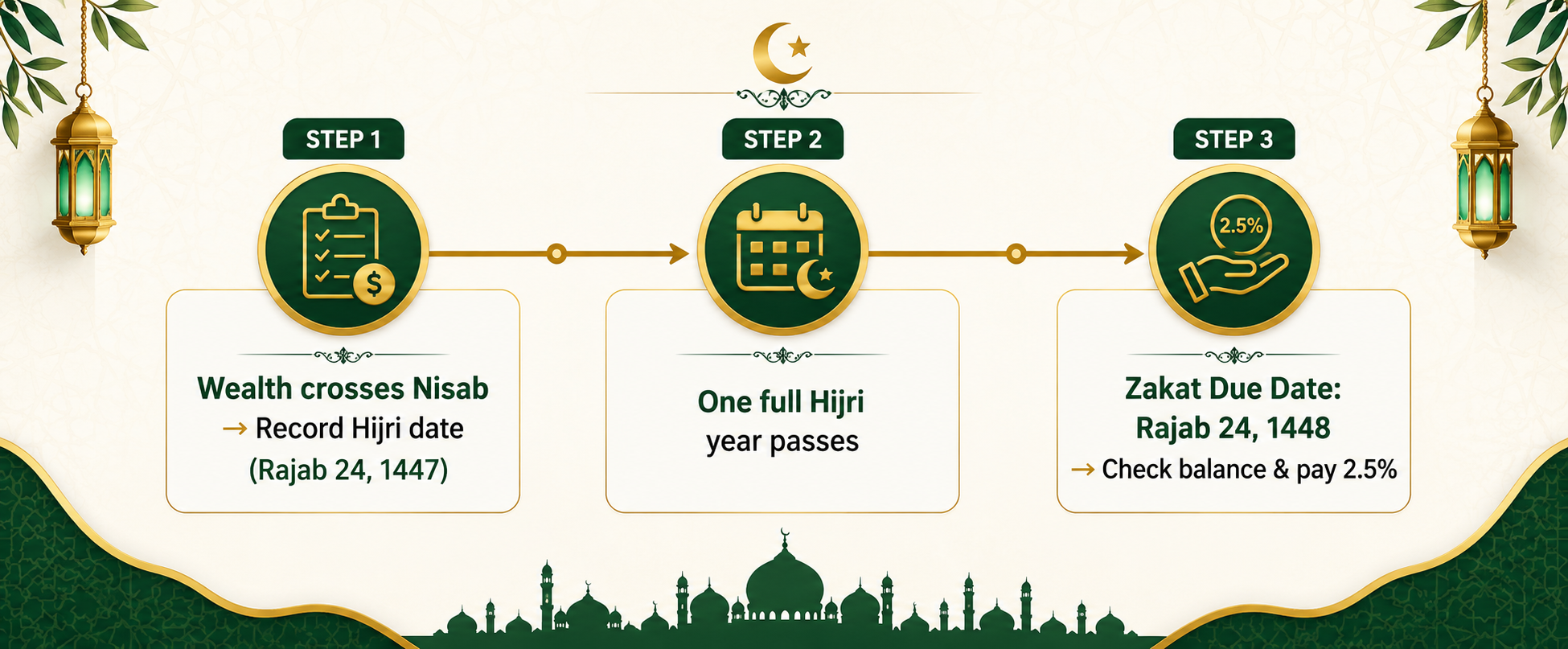
So if you have $2,000 sitting in savings right now, you've crossed the silver Nisab. You're one condition away from Zakat being due (pending the fifth condition, which is that a full Islamic lunar year passes on that amount).
⚠️ NOTE: The Hanafi school and some contemporary scholars from other traditions recommend using the silver Nisab for cash, as it benefits more of the poor. If you follow the Maliki, Shafi'i, or Hanbali schools, the gold Nisab (~$12,000+) is the standard.
What About Jewelry
This is probably the question sisters ask most.
The majority of scholars say no: Personal-use jewelry that you regularly wear is not zakatable. You're adorning yourself with it, not hoarding it as currency. Wear your gold in peace.
Imam Abu Hanifah disagrees. His position is based on the general ruling that all gold and silver has Zakat due on it, as evidenced by the hadith where the Prophet ﷺ asked Aisha (RA) whether she had paid Zakat on her rings, implying they were subject to it.
Abdallah bin Shaddad narrated that A'ishah (ra) stated that the Prophet (ﷺ) saw two silver rings in her hand and questioned her regarding paying zakat on them. When she replied that she did not, he stated, "This is sufficient for you (to take you) to the Hell fire. (sunnah.com)
The authenticity of this hadith is debated, but Imam Abu Hanifah uses it alongside the general Quranic principle that gold and silver carry Zakat.
A nuanced position that sits between the two: If a woman owns a *significant* amount of gold that she rarely wears and is essentially saving as an asset (not as jewelry she actually uses), it's closer to piety to pay Zakat on it. But for the woman who wears her jewelry regularly and isn't sitting on a vault of gold she never touches? The majority scholarly position covers her, and there's nothing to worry about.
The Most Common Zakat Mistakes
1. Giving sadaqah with no Zakat intention and assuming it counts.
It does not. Intention is set at the time of giving. You can't retroactively declare a past donation as your Zakat. If you have given something as charity, then that is charity, and cannot be converted to zakat.
2. Calculating by the Gregorian calendar.
Zakat runs on the Islamic lunar (Hijri) year, which is roughly 11 days shorter. Use the right calendar.
3. Not knowing who the recipients are.
Zakat has eight specific Quranic categories of eligible recipients. Giving to a cause that doesn't qualify (even a worthy one) doesn't fulfill your Zakat.
4. Forgetting about children's wealth.
If your child has savings that meet all five conditions, Zakat may well be due on it. Don't assume their money is exempt just because they're young.
5. Assuming taxes count.
They don't. Taxes are a government obligation. Zakat is an obligation to Allah. They are two completely separate things.
Frequently Asked Questions About Zakat
Q: Is Zakat based on my income or my savings?
Primarily your savings and accumulated wealth — gold, cash, investments — not your monthly income directly.
Q: What if I can't calculate Zakat myself?
The Zakat calculator has been created to make it easy for you. Or you can visit an Islamic scholar — the same way you'd go to a tax accountant. You don't have to be a math person. You just have to take it seriously.
Q: Are orphans automatically eligible to receive Zakat?
No. An orphan who has wealth doesn't qualify just because they're an orphan. Eligibility is based on financial need, not family status.
Q: Can I give Zakat to family members?
Sometimes. You can't give it to those you're already financially responsible for — your spouse, your children. But needy extended family members? In many cases, yes, and they may even be prioritized.
Q: Does paying taxes count as Zakat?
No — see above. They are two different systems with two different purposes.
The Quick Checklist: Do You Owe Zakat?
Run through these five boxes. All five need to be checked:
- [ ] You are Muslim
- [ ] The wealth is a zakatable type (cash, gold, trade goods, etc.)
- [ ] You have full ownership and control of it right now
- [ ] It meets or exceeds the Nisab (~$1,500+ by silver standard as of writing this post)
- [ ] A full Islamic lunar year has passed on that wealth (Part 2)
If every box is checked, then Zakat is due. The rate on currency and trade goods is 2.5% of the total zakatable amount. Two and a half cents on every dollar.
A Closing Thought: This Is Not a Burden
2.5%. That's what we're talking about. Two and a half cents on every qualifying dollar — in exchange for purified wealth, forgiven sins, and barakah you can't always see but will absolutely feel.
We spend enormous energy finding legal ways to reduce our taxes. We hire accountants. We track every deduction. And there's nothing wrong with that. But Zakat? Who are we running from there? Allah already knows the number. The question is whether we care enough to calculate it honestly.
Every dollar of Zakat goes directly to reduce real poverty — in your community, across the ummah, around the world. You're not just ticking a box. You're being the vehicle through which wealth reaches the people it was always meant to reach.
May Allah accept it from all of us. Ameen.
---
This is Part 1. Read Part 2 here.
Related articles

Qurbani (Udhiyah): The Animal, the Timing, the Slaughter, and the Distribution — A Complete Practical Guide
Which animals are valid for Qurbani? What defects invalidate the sacrifice? When must it be slaughtered? How is the meat distributed? Every practical question answered with scholarly sources.

Qurbani (Udhiyah): The Sacrifice of Eid al-Adha — What It Is, Who Owes It, and What Happens If You Miss It
What is Qurbani and who is required to give it? Learn the basis, the ruling across the madhabs, who qualifies, if one sacrifice covers a whole household, and what to do if you've missed in past years.
How to Calculate Zakat: The 5th Condition, Nisab Thresholds, and the Simple 2.5% Formula
Learn the 5th and final condition for Zakat, how to determine your Nisab threshold, how to handle fluctuating wealth and debt, and how to calculate exactly how much Zakat you owe in 2026.